
New Zealand
New Zealand’s long history of living in harmony with nature and deep knowledge of the marine environment. This, together with having the ideal conditions to cultivate giant kelp, make it a clear choice for our second operating location.
In New Zealand, we have piloted cultivating Macrocystis Pyrifera in our onshore hatchery in Bluff and outplanting this onto marine farms in Akaroa Harbour. Based on this experience and with a new partnership with Awarua Rūnaka Limited we have decided to follow our ambition to establish a large scale kelp farm in Southland.
Proposed Expansion in Southland
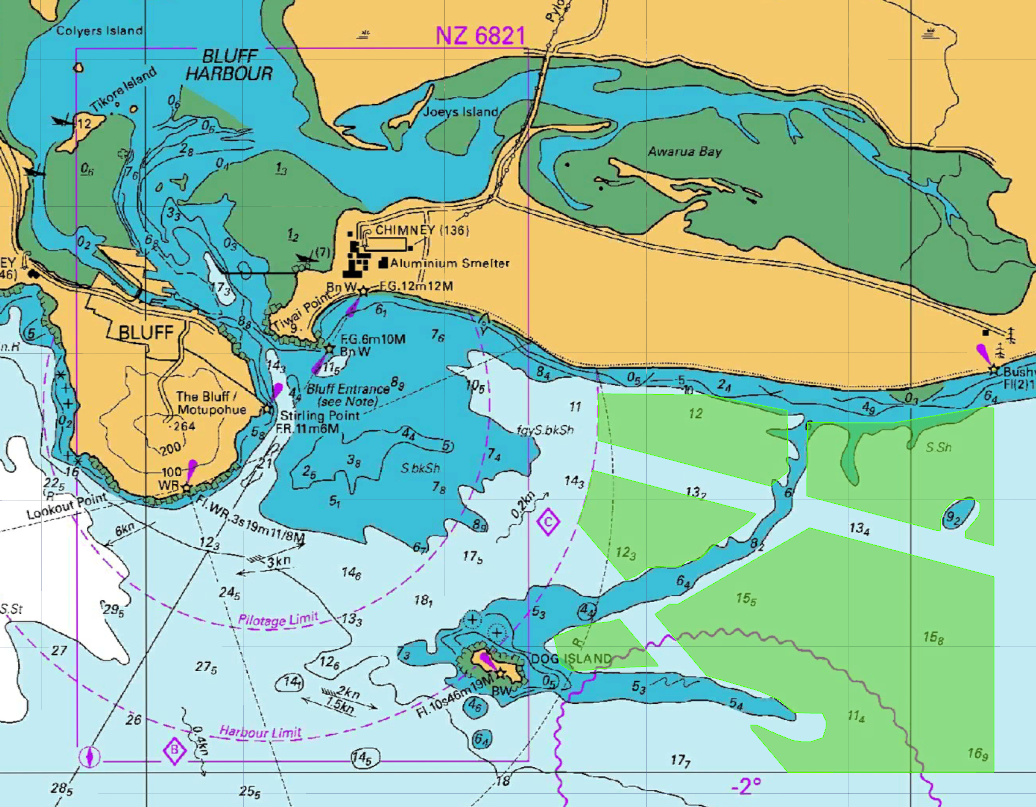
Kelp Blue is excited to be supporting Awarua Rūnaka Limited with a proposal to farm Macrocystis in the cold nutrient rich waters of Te ara a Kiwa/Foveaux Strait, Southland.
In 2024 - after time on the water, engaging with stakeholders, and hosting public consultations - we chose a site that has the necessary criteria for our operations. Awarua `Rūnaka Limited, Kelp Blue and a long list of technical experts have been working to prepare a resource consent application for 2,850ha of marine space.
If approved, our farming operations will follow a staged approach. This means we will start small, regularly monitor our work and its impact, and implement these lessons so we adapt and continuously improve how we farm.
The operations will start by establishing a marine monitoring programme (including marine mammals, seabirds, and water quality). Next a series of navigational aids will be put in place in consultation with the Harbourmaster and MaritimeNZ. Then we will start installing screw anchors to secure the submerged structures the kelp will grow on. These structures will be seeded with tiny Macrocystis plants and will be regularly monitored throughout their life to track the environmental conditions, biodiversity, kelp growth and the structures themselves.
Consultations - Let’s work together.
Awarua Rūnaka Limited and Kelp Blue are actively seeking input and feedback from the community and stakeholders on our proposal.
We invite input and feedback, so please follow contact us on nz@kelp.blue or the link to the public consultation survey.

FAq

- New Zealand's cold, nutrient-rich waters create ideal conditions for successful and sustainable kelp growth.
- New Zealand’s existing aquaculture, fishing, agricultural and horticulture industries provide the skilled workforce, equipment and know-how we need to develop a new primary industry in New Zealand. As well as demand for our first product, StimBlue+ biostimulant!
- Awarua Rūnaka Limited and Kelp Blue are preparing an application for 2,850ha of marine space to farm Macrocystis off Bluff.
Awarua Rūnaka Limited and Kelp Blue are working together to develop seaweed farming in the Awarua takiwa. Awarua is preparing a resource consent application for a coastal marine space. Kelp Blue is providing technical support for the application. If successful, Awarua will hold the farm consent, and Kelp Blue will farm the space and operate onshore hatchery and processing factory.
Kelp Blue: introduction video (3mins)
Yes, Macrocystis is native to New Zealand and is commonly known as Bladder Kelp or Giant Kelp. Giant kelp is found globally including along the coast of the eastern Pacific Ocean, from California to Alaska, and in the southern oceans near South America, South Africa, and Australia.
In New Zealand, it can be found from the Wairarapa/Kapiti coasts to the Sub-Antarctic Islands. It prefers cooler waters of 12-14oC and naturally occurs in water depths of 10-15 meters where it attaches to the rocky substrate. Depending on conditions, kelp can grow up to 45 meters in length and at speeds of 50 centimetres per day. These individuals have a lifespan of 2-6 years, during which they naturally die back in the summer and re-grow in the autumn. (David R. Schiel and Michael S. Foster, 2015)
The Ministry of Primary Industries regulates where farmers can collect Macrocystis sori – fertile seaweed material found on fronds – for cultivation. Under these regulations we harvest sori from naturally occurring kelp found growing on marine farms licensed to farm Macrocystis within New Zealand.
The farm structure will consist of lines submerged to around 5-10m below the water’s surface, kept under constant tension and secured by screw anchors designed in New Zealand. The design, materials and maintenance schedule have been chosen to maximise kelp growth while minimising environmental impact, risk of marine mammal entanglement or impact on the visual landscape. The only parts of the farm visible on the surface will be the floating kelp canopy and the navigation aids required by maritime law.
Kelp cultivation has various positive impacts including:
- Kelp forests are positive ecological engineers - meaning they create nurseries and spawning grounds for different species - and therefore increase biodiversity.
- Kelp forests provide other ecosystem services, including boosting stocks of commercially valuable species, bioremediation for coastal pollution, localised control of ocean acidification, and carbon sequestration.
- Cultivated kelp farming does not use feed inputs or create discharges.
To ensure we understand the environmental impact once we are operational - both positive and any potential negative impact - we will establish a Marine Monitoring Programme to regularly collect and analyse data including on water quality, benthic and species presence/behaviour.
Kelp Blue is cognisant of the unique and threatened marine species in the wider area, as well as the importance of the moana for iwi and industry, so have prepared environmental management plans to ensure best practice. These plans include a Marine Mammal Management Plan, Seabird Management Plan, Shark Management Plan and a Biosecurity Management Plan.
The reality of operating in the marine environment is that there will always be a risk of marine mammal entanglement. Kelp Blue has experience in mitigating and monitoring these risks
gained through developing our farm in Namibia and setting up operations in Alaska. In New Zealand, we have engaged Dr. Simon Childerhouse, a New Zealand based world-renowned marine mammal expert, to undertake a risk assessment, share risk mitigation strategies and prepare a Marine Mammal Monitoring Programme. Kelp Blue will actively collaborate with other industry, iwi and projects working on marine mammals in Foveaux Strait.
Our New Zealand project will also benefit from Kelp Blue’s:
- consultations with international experts from South Africa and the United States;
- commissioned research on how to optimise our farm design to minimise risks of entanglement;
- experience implementing marine monitoring programmes to better understand the mammals’ behaviour and the impact of our structures on this; and
- experience of training a team (Namibia) in marine mammal identification and basic marine mammal and seabird disentanglement techniques.
Through research from and consultation with Ministry of Primary Industries, Dr. Simon Childerhouse, the South African Whale Disentanglement Network, and the Alaska Department of Fish & Game Marine Mammal Research Program we understand that measures, including the following, will minimise this risk:
- A Marine Mammal Management Plan has been developed by Dr. Simon Childerhouse, a New Zealand based world-renowned marine mammal expert, who works closely with the Department of Conservation and Ministry for Primary Industries.
- Monitoring (including visual and acoustic) will be undertaken to improve knowledge of marine mammal (as well as seabirds and shark) species occurrence and migration pathways through the area and the farm as well as how they perceive offshore farm structures visually and acoustically.
- Farm structure design includes all mooring lines/blocks being more than 25m apart, and individual lines being more than 4m apart.
- Farm structure installation and maintenance will include all mooring hawsers, rope arrays and ropes to floats being rigid or under constant tension. The tension is to be monitored and maintained regularly.
- Artificial lighting at farming sites will only be used as required by Maritime NZ and the Harbourmaster for farm demarcation for navigation.
- Kelp Blue operation teams will be trained in marine mammal identification, and we will engage with DOC and other industry regarding upskilling on support for marine mammal and seabird disentanglement techniques.
Our first seaweed is Macrocystis pyrifera as it is the fastest growing seaweed, is naturally buoyant and is a perennial that grows to create a forest and canopy. Unlike many other seaweeds, this means that Kelp Blue can sustainably rotationally harvest the Macrocystis canopy while leaving the ecosystem to flourish. Also, it’s natural buoyancy, means the farm structures can be submerged reducing the infrastructure on the surface and the visual impact of the farm.
We love seaweed and never-say-never so maybe there will be more species in the future!
At the small scale we would harvest using small vessels and cutting by hand. However, in time, we would like to use the same technology being developed for Namibia, which involves a remote-controlled, renewable energy-powered harvester that cuts the canopy about 1.5m below the surface, leaving the rest of the plant to grow and the forest to flourish.
We rotationally harvest the farm and given the growth rates of Macrocystis, we believe we can harvest each area of the farm between 2-4 times a year.
Kelp has been used by humans across the globe for hundreds, if not thousands of years, for various purposes. These have included providing nutrients for crops, soils, and humans. These simple uses have withstood the test of time, but with today’s knowledge and technology, even more uses for kelp are being uncovered.
Kelp Blue’s processing uses a biorefinery approach which means that every piece of kelp that goes into the factory is used to produce a product.
The first product is a seaweed biostimulant - StimBlue+. Biostimulants help crops to cope with climatic stresses, increase crop yield and quality, and improve soil health. StimBlue+ blends easily with farmers current crop regimes and can help to reduce the use of synthetic fertilizers. StimBlue+ is registered in 70 markets around the world and is certified as anorganic input in many including by BioGro in New Zealand.
Other products in development include a kelp ‘leather’, extractions of alginates (used for
high-quality food thickeners, bio-packaging) and fucoidans (a source of prebiotics and has
many antioxidants, anticancer, anti-inflammatory, and antimicrobial properties).
Kelp Blue aims to process the kelp as quickly as possible after harvesting to ensure its freshness and minimise travel. Therefore, all onshore processing facilities will be located in Bluff, alongside our offshore operations.
Yes! The kelp farm will grow in stages as we better understand the growing conditions in Te Ara a Kiwa. At the fully developed stage our plans include navigation channels to ensure that there is clear access through the farm. Also in terms of use of space, Awarua are requesting for preferential access. This means that we will be able to safely manage the installation and maintenance of the farm structures alongside the outplanting and harvesting of the kelp, while still enabling recreational use of the space.
Kelp Blue Aotearoa Forestry Limited was registered as a company in New Zealand in March 2023. It operates as part of the global Kelp Blue group which has its head office in Amsterdam, the Netherlands. Kelp Blue runs farming and processing operations in Namibia, has operated pilot farms in New Zealand, and is investigating expanding into Chile.
In each location, Kelp Blue registers local companies and establishes the entire value chain from cultivating and farming the Macrocystis through to harvesting and processing these into products for both domestic consumption and export.
Financially the start-up phase of this process is supported by Kelp Blue’s Holding Company, which is registered in the Netherlands. Once each country has licenses and momentum then we begin a process of domestic fundraising to ensure that locals have the ability to invest into the company and its work. Further, a percentage of the shares of each company are held for local staff.
One of the biggest benefits of being part of a global group is the ability for each country to support the establishment and learning of one another. For example, in New Zealand we have benefitted by bringing in Namibian marine biologists to support the creation of our monitoring plans, and engineers with experience in Operations and Structure Design/Installation from Amsterdam to help us to plan our expansion. This enables us to stand on the shoulders of giants and ensures we are not reinventing the wheel. We see this rotation of staff and knowledge continuing and growing as the company expands so that hopefully soon it will be Kiwi staff travelling to Namibia, Alaska and Chile to support those teams!
Yes, we are definitely going to employ local people!
The roles Kelp Blue will be looking for will include divers, skippers, deckhands, finance support, marine biologists, offshore engineers, marine ecologists, mechanical engineers, biochemical engineers, process engineers, operators, technicians, R&D specialists, agronomists, sales support and more. The employment process will scale up as Kelp Blue moves through each stage of set up and expansion. Given the skills we require we are already working with institutions such as Southern Institute of Technology, Nelson Marlborough Institute of Technology and Ocean Beach to provide guidance on the skills our employees will need and to provide students in getting industry experience through research projects, internships and part-time work.
Please do be in touch and or submit a survey via our website.
Careers
We’re not a ‘business as usual’ scale-up. We value originality and creativity, expect a healthy dose of common sense, that you are a problem solver by nature and that you’re comfortable getting on with tasks in an unstructured environment.
If you feel like you’re a good fit, please get in touch. You might be what we are looking for and we don’t even know it.
We’re always on the look out for those who want to join us on our journey to leave the planet in a better place. Send us an email with your resume to newkelpies@kelp.blue
Transform Your Farm with StimBlue+
Ready to boost your yields and enhance soil health? Contact our team of agronomists to learn how StimBlue+ can benefit your farm. Our team is ready to answer all your questions, comments, and requests.
